Safeguarding Policy – The Bread Kitchen CIC
(the definitive version of this policy is the PDF - which is available here.)
Section 1. Introduction (Aim / Ethos)
AIM-This policy sets out our commitment to safeguarding and promoting the welfare of all children. At The Bread Kitchen CIC we provide Alternative Provision/Education and youth club provision for children from age 5-16 years and family homeschool sessions for children aged 0-16 years. We want all children to feel safe and secure, and by following the procedures within the policy we will uphold our legal duty to safeguard children in our care.
Ethos-The Bread Kitchen CIC fully recognises our responsibility to protect children from harm. We strive to promote the positive wellbeing of all children in our care by providing a nurturing and supportive environment, where children can learn safely. Our policy applies to all children, staff, volunteers, visitors, parents and students. All staff and volunteers will be trained to respond to a disclosure from a child and will know the procedure to follow.
Section 2. Name and contact details of the Designated Safeguarding Person (DSP) and their Deputy
DSP : Sandy Simmons
Deputy : Mike Smith-Clare.
Deputy : Jo Woodhouse.
If the DSP//Deputy DSP are unavailable anyone with a safeguarding concern can contact The Children’s Advice and Duty Service (CADS).
A staff member or volunteer can call (0344 800 8021) and choose from the following options:
Option 1-the child or young person is currently being supported by a Social Worker or Family Practitioner.
Option 2-your call relates to Child Exploitation.
Option 3-your call relates to Domestic Abuse.
For all other Safeguarding Concerns please hold until your call is answered.
A parent or member of the public can call (0344 800 8020).
If you feel it is an emergency call the Police on 999.
3. Roles and Responsibilities of DSP
- -The named person that safeguarding concerns are reported to.
- -Liaise with Children’s Services and other agencies and make referrals to The Children’s Advice and Duty Service or Local Authority Designated Officer (LADO) when required.
- -Responsible for making sure the policy is reviewed yearly and updated when changes happen at local/national level.
- -Ensure all staff/volunteers/visitors/parents are aware of this policy and the procedures to follow.
- -Ensure all staff and volunteers have received appropriate safeguarding information during induction and have received safeguarding training.
- -Ensure that safer recruitment practices are followed.
- -Update staff on changes to safeguarding.
- -Completed DSP Training.
- -Follow the Norfolk Continuum of Needs Guidance produced by the Norfolk Safeguarding Children Partnership (NSCP).
Section 4: Safer Working Practices for staff and volunteers
-How are staff/volunteers made aware of this policy and any changes?
Staff sign a distribution sheet and resign each time changes are made.
-What Safer Recruitment steps are in place?
Appropriate job description, person specification, application form, interview, references and qualifications checked.
See also our Safer Recruitment Policy.
-What is the procedure for DBS Checks?
We will always gain the correct level of DBS disclosure appropriate to the role.
There is no official expiry date for a paper DBS certificate. However, our organisation will request a new paper DBS check every _3_ years as part of our ongoing safer working practices.
-What is the safeguarding induction process for staff / volunteers?
As part of their induction, staff and volunteers read all polices and procedures connected to safeguarding, have a meeting with the DSP/DSL to understand how to record and report safeguarding concerns and undertake basic safeguarding children training, preferably via SAFER.
-What training will staff/ volunteers have? (Safeguarding / First Aid)
It is important that as a minimum anyone having with contact with children (including volunteers) should attend the Safer Programme’s Introduction to Child Safeguarding Course or an equivalent level course. This should be renewed every 3 years.
Code of Conduct
All staff and volunteers will be given a copy of our Code of Conduct and will be asked to read this and sign to confirm they will adhere to this, which forms part of our safer working practices.
Section 5: Procedure for handling a disclosure from a child
Key points to consider when dealing with a disclosure:
- Listen and be supportive.
- Do not ask any leading questions, interrogate the child, or put ideas in the child’s head, or jump to conclusions.
- Do not stop or interrupt a child who is recalling significant events.
- Never promise the child confidentiality– it must be explained that information will need be to be passed on to help keep them safe.
- Record what was said immediately as close to what was said as possible. Also record what was happening immediately before the child disclosed.
- Name, sign and date the record in ink.
- Contact the DSP immediately who will decide on what action to take.
Section 6- Contacting The Children’s Advice and Duty Service (CADS)
If we have an emergency, we will call the Police on 999.
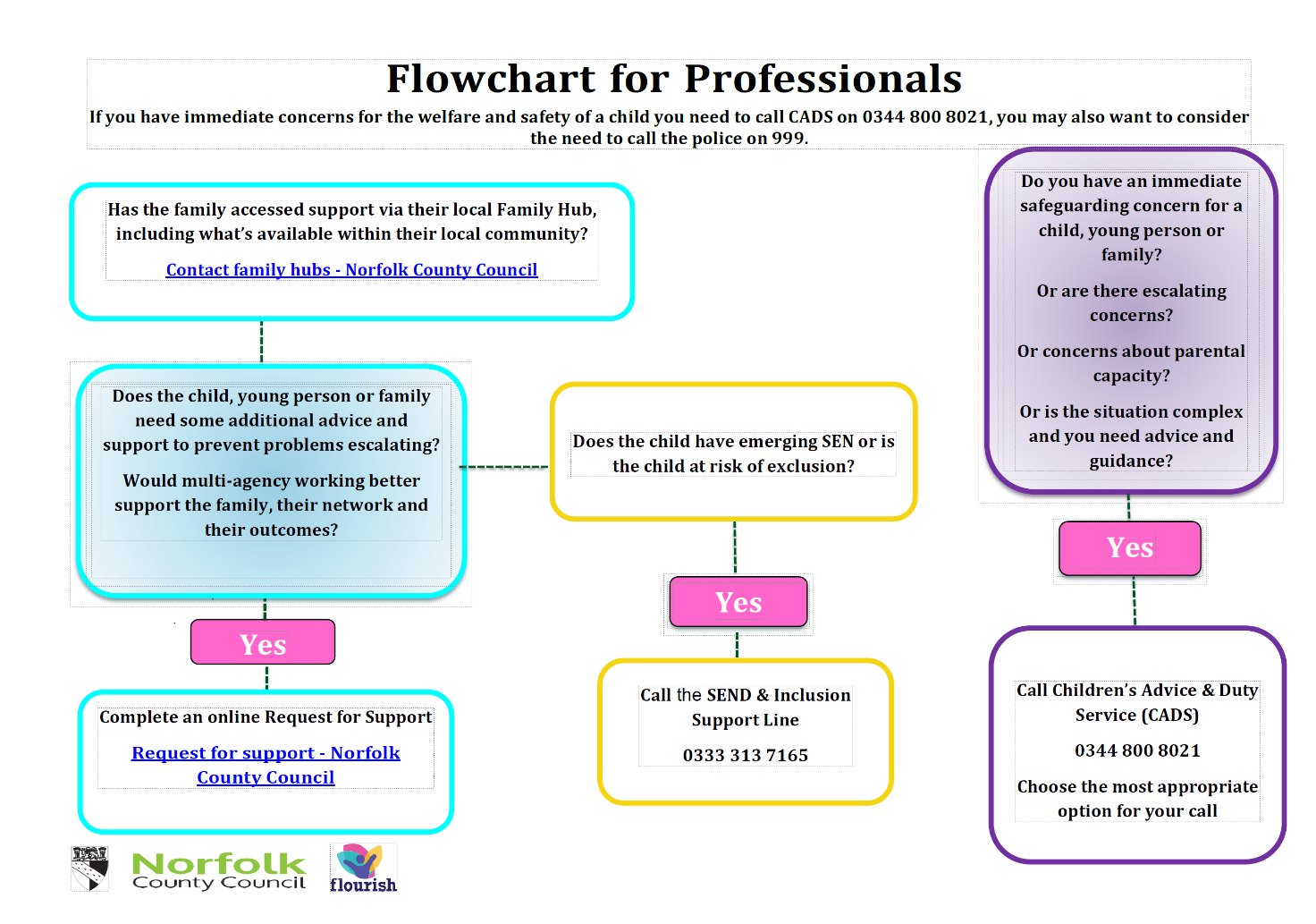
We will contact CADS when there are concerns about a child’s safety or wellbeing, and we believe they may be at risk of harm. This includes:
- Immediate Safeguarding Concerns - where a child is at risk of significant harm, including physical, emotional, sexual abuse, or neglect.
- Escalating Concerns - Where previous support or interventions have not improved the situation and concerns are increasing.
- Concerns About Parenting Capacity - Where a parent or carer’s ability to meet a child’s needs is compromised due to issues such as substance misuse, mental health, or domestic abuse.
- Professional Consultation - Where the situation is complex and you require advice or guidance on appropriate next steps.
We will contact CADS on their direct line: 0344 800 8021.
We will choose from the following options:
- Option 1 -the child or young person is currently being supported by a Social Worker or Family Practitioner.
- Option 2 -your call relates to Child Exploitation.
- Option 3 -your call relates to Domestic Abuse.
For all other Safeguarding Concerns please hold until your call is answered.
We will have the following information ready before contacting CADS:
- all of the details known to your organisation about the child (including DOB, current address, contact details for the family, the family composition including siblings, and where possible extended family members and anyone important in the child’s life)
- the nature of the concern and worries
- history of the family (including significant events)
- any work/support you have provided to the child or family to date.
- where the child is now
- whether you have informed parents/carers of your concern
- When considering whether to contact CADS we will consult the CADS Flowchart in Appendix 4 and CADS FAQs on the NSCP Website Page: How to Raise a Concern | Norfolk Safeguarding Children Partnership | PWWC
- We will also consult the Norfolk Continuum of Needs Guidance 2023 produced by the Norfolk Safeguarding Children Partnership (NSCP)
- We will gain consent from the parent to contact CADS, unless the concerns being raised suggest that the child or someone else (including the referrer) would be placed at risk of significant harm, or it might undermine the investigation into a serious crime.
- Reasons for not seeking consent should be clearly stated when contacting CADS and recorded on internal systems for our records.
- We will have a discussion with a Consultant Social Worker.
- A copy of the discussion will be securely emailed to us.
- We will follow the advice given.
- We will keep written dated records of all conversations with CADS, for our own safeguarding recording process.
- We will not investigate and will be led by the Local Authority and/or the Police.
- We understand if we are unhappy about a decision made by CADS, we can use the Resolving Professional Disagreements policy on https://norfolklscp.org.uk/
- Parents or members of the public can contact CADS on 0344 800 8020
Requesting Early Help support
For concerns that do not meet the above threshold, Early Help support & guidance can be accessed via Request for support - Norfolk County Council.
Early Help is designed to support children, young people, and families experiencing difficulties that may affect their wellbeing, development, or ability to flourish. It aims to:
- Prevent problems from escalating by addressing issues early.
- Support the wider family context, including parents, carers, and siblings.
- Improve outcomes such as school attendance, mental health, and relationships.
- Encourage multi-agency working, bringing together professionals to create a coordinated support plan.
- Empower families by focusing on strengths and helping build resilience.
Concerns about Radicalisation and Extremism
If we have concerns that a child or young person could be vulnerable to radicalisation, we will follow the procedure in Appendix 1.
Section 7-Types of Abuse
Definitions of Abuse and Neglect from Working Together to Safeguard Children 2023
Safeguarding and promoting the welfare of children is defined for the purposes of this guidance as:
- providing help and support to meet the needs of children as soon as problems emerge
- protecting children from maltreatment, whether that is within or outside the home, including online
- preventing impairment of children’s mental and physical health or development
- ensuring that children grow up in circumstances consistent with the provision of safe and effective care
- promoting the upbringing of children with their birth parents, or otherwise their family network
- taking action to enable all children to have the best outcomes
Child protection is part of safeguarding and promoting the welfare of children and is defined for the purpose of this guidance as activity that is undertaken to protect specific children who are suspected to be suffering, or likely to suffer, significant harm. This includes harm that occurs inside or outside the home, including online.
What is abuse and neglect? Abuse - A form of maltreatment of a child. Somebody may abuse or neglect a child by inflicting harm, or by failing to act to prevent harm. Harm can include ill treatment that is not physical as well as the impact of witnessing ill treatment of others. This can be particularly relevant, for example, in relation to the impact on children of all forms of domestic abuse, including where they see, hear, or experience its effects. Children may be abused in a family or in an institutional or extra-familial contexts by those known to them or, more rarely, by others. Abuse can take place wholly online, or technology may be used to facilitate offline abuse. Children may be abused by an adult or adults, or another child or children.
Physical abuse - A form of abuse which may involve hitting, shaking, throwing, poisoning, burning, or scalding, drowning, suffocating, or otherwise causing physical harm to a child. Physical harm may also be caused when a parent or carer fabricates the symptoms of, or deliberately induces, illness in a child.
Emotional abuse -The persistent emotional maltreatment of a child so as to cause severe and persistent adverse effects on the child’s emotional development. It may involve conveying to a child that they are worthless or unloved, inadequate, or valued only insofar as they meet the needs of another person. It may include not giving the child opportunities to express their views, deliberately silencing them, or making fun of what they say or how they communicate. It may feature age or developmentally inappropriate expectations being imposed on children. These may include interactions that are beyond a child’s developmental capability, as well as overprotection and limitation of exploration and learning, or preventing the child participating in normal social interaction. It may involve seeing or hearing the ill-treatment of another. It may involve serious bullying (including cyber bullying), causing children frequently to feel frightened or in danger, or the exploitation or corruption of children. Some level of emotional abuse is involved in all types of maltreatment of a child, though it may occur alone.
Sexual abuse - Involves forcing or enticing a child or young person to take part in sexual activities, not necessarily involving a high level of violence, whether or not the child is aware of what is happening. The activities may involve physical contact, including assault by penetration (for example, rape or oral sex) or non-penetrative acts such as masturbation, kissing, rubbing and touching outside of clothing. They may also include non-contact activities, such as involving children in looking at, or in the production of, sexual images, watching sexual activities, encouraging children to behave in sexually inappropriate ways, or grooming a child in preparation for abuse Sexual abuse can take place online, and technology can be used to facilitate offline to commit acts of sexual abuse, as can other children.
Neglect - The persistent failure to meet a child’s basic physical and/or psychological needs, likely to result in the serious impairment of the child’s health or development. Neglect may occur during pregnancy as a result of maternal substance abuse.
Once a child is born, neglect may involve a parent or carer failing to:
- provide adequate food, clothing, and shelter (including exclusion from home or abandonment)
- protect a child from physical and emotional harm or danger
- ensure adequate supervision (including the use of inadequate caregivers)
- ensure access to appropriate medical care or treatment
- provide suitable education It may also include neglect of, or unresponsiveness to, a child’s basic emotional needs
For information on indicators of abuse consult Appendix 2.
Additional safeguarding concerns to be aware of are:
- Child Sexual Exploitation
- Child Criminal Exploitation
- FGM – Female Genital Mutilation
- Forced Marriage
- Honour Based Abuse
- County Lines
- Domestic Abuse
- Online Abuse
- Radicalisation
For more information on these consult Appendix 3.
Section 8-Managing Allegations against people working or volunteering with children
Our aim is to provide a safe and supportive environment which secures the wellbeing and very best outcomes for the children who attend our setting. We do recognise that sometimes the behaviour of adults may lead to an allegation of abuse being made.
Allegations sometimes arise from a differing understanding of the same event, but when they occur, they are distressing and difficult for all concerned. We also recognise that many allegations are genuine and there are some adults who deliberately seek to harm or abuse children. We work to the thresholds for harm as set out in ‘Working Together to Safeguard Children’ (2023).
An allegation may relate to a person who works / volunteers with children who has:
- behaved in a way that has harmed a child, or may have harmed a child and/or;
- possibly committed a criminal offence against or related to a child and/or;
- behaved towards a child or children in a way that indicates he or she may pose a risk of harm to children; and/or
- behaved or may have behaved in a way that indicates they may not be suitable to work with children.
The 4th bullet point above recognises circumstances where a member of staff (including locum or supply staff) or volunteer is involved in an incident outside of setting/agency/workplace which did not involve children but could have an impact on their suitability to work with children; this is known as transferrable risk.
At The Bread Kitchen CIC we recognise our responsibility to report / refer allegations or behaviours of concern and / or harm to children by adults in positions of trust known to us, but who are not employed by our organisation to the LADO service directly at
We will take all possible steps to safeguard our children and to ensure that the adults at The Bread Kitchen CIC are safe to work with children. When concerns arise, we will always ensure that the safeguarding actions outlined in the local protocol and procedures NSCP Protocol 8.3 Allegations Against Persons who work/volunteer with children and The Management of Allegations Against People Working with Children Procedure are adhered to and will seek appropriate advice.
If an allegation is made or information is received about any adult who works/ volunteer in our setting which indicates that they may be unsuitable to work / volunteer with children, the member of staff receiving the information will inform The Bread Kitchen CIC immediately. This includes concerns relating to agency, supply and specialist staff, students and volunteers.
The DSP, should within 1 working day, report the allegation to the LADO in accordance with this procedure, by completing a LADO referral form.
Should an allegation be made against the DSPthis will be reported to Mike Smith-Clare In the event that Mike Smith-Clare is not contactable on that day, the information must be passed to and dealt with by Jo Woodhouse.
The LADO referral form can be downloaded here under the LADO tab, along with more information: https://norfolklscp.org.uk/people-working-with-children/how-to-raise-a-concern
For further information on the role/remit of Norfolk LADO Service, please see NSCP Protocol 8.3 Allegations Against Persons who work/volunteer with children and The Management of Allegations Against People Working with Children Procedure
Section 9- Disciplinary Procedures when an allegation has been made against a staff member or volunteer
If an allegation is made against a staff member or volunteer they will be suspended pending the outcome of an investigation.
Section 10 Low level concerns about adults working or volunteering with children which do not meet the harm threshold for a LADO referral
A low-level concern is any concern, doubt, or sense of unease, no matter how small, that someone may have acted in a way that is inconsistent with your organisations code of conduct.
Behaviour that might be considered as inappropriate often depends on the circumstances. A low-level concern may not be seen as immediately dangerous or intentionally harmful to a child, but it can soon escalate and become a serious safeguarding concern.
Examples of such behaviour could include:
- Being over friendly with children
- Excessive 1-1 to attention beyond what is required for their role
- Having favourites
- Adults taking photographs of children on their mobile phone
- Engaging with a child on a one-to-one basis in a secluded area
- Using inappropriate sexualised, intimidating or offensive language
- Inappropriate sharing of images
- Humiliating children
This list of examples is not exhaustive, and low-level concerns can arise from various forms of behaviour.
Low-level concerns may arise in several ways and from several sources. For example: suspicion; complaint; or disclosure by a child, parent or other adult within or outside of the organisation.
At our organisation we promote an open and transparent culture in which all concerns about all adults working in or volunteering on behalf of our organisation are dealt with promptly and appropriately.
Through induction, we ensure all staff/volunteers understand the importance of self-referring, where, for example, they have found themselves in a situation which could be misinterpreted, might appear compromising to others, and/or on reflection they believe they have behaved in such a way that they consider falls below the expected professional standards.
Managing a Low-Level Concern
At our organisation staff/volunteers are expected to report all low-level concerns immediately to the DSP
If reported to the DSP they will inform Mike Smith-Clare of the concern.
The DSP will be the ultimate decision maker in respect of all low-level concerns.
At our organisation we understand the importance of recording low-level concerns and the actions taken in light of these being reported. We will review the records we hold to identify potential patterns and take appropriate action. This could be through a disciplinary process, or where a pattern of behaviour moves from a low-level concern to meeting the harm threshold, where it should be referred to the LADO.
If our organisation is in any doubt as to whether the information which has been shared about a member of staff/volunteer as a low-level concern in fact meets the harm threshold, they should consult with the LADO on
Section 11- Making a Barring Referral to the Disclosure and Barring Service
If an allegation has been made about a staff member or volunteer, then our organisation has a legal duty to make a barring referral if the following conditions are met:
Condition 1
- you withdraw permission for a person to engage in regulated activity with children and/or vulnerable adults. Examples: dismissed, re-deployed, retired, been made redundant or retired.
Condition 2
You think the person has carried out 1 of the following:
- engaged in relevant conduct in relation to children and/or adults. An action or inaction has harmed a child or vulnerable adult or put them at risk or harm or;
- satisfied the harm test
- received a caution for, or a conviction for, or been convicted for a relevant offence
More information on Barring Referrals can be found online. If we need guidance on making a Barring Referral, we will contact the East of England DBS Outreach Advisor for support. A Barring Referral can be completed online via the DBS website.
The DSP – Sandy Simmons - will have the responsibility for making a barring referral. If the allegation is against Sandy Simmons, Mike Smith-Clare will make this barring referral
There could be times when we might consider that we should still make a referral in the interests of safeguarding children even if the legal duty to refer has not been met. This could include acting on advice of the police or a safeguarding professional, or in situations where there may not be enough evidence to dismiss or remove a person from working with vulnerable groups. DBS are required by law to consider any and all information sent to them from any source. This includes information sent to them where the legal referral conditions are not met. If we do make a referral to DBS where the referral conditions are not met, we will do so in consideration of relevant employment and data protection laws.
Section 12-Working with Parents/Carers
-Parents will sign a service level agreement at the start of their child’s involvement, which will include a copy of the safeguarding policy and the statements below.
- Parents will be informed of our legal duty to assist other agencies with Safeguarding enquiries and that we will we contact The Children’s Advice and Duty Service (CADS) and or Police if we have concerns about the welfare of their child.
- Parents will be made aware that we will need to share information with the relevant authorities if we have concerns about the welfare of their child, and that we do not have to seek consent from them if there are serious concerns about harm or likely harm to their child.
Section 13- Records and Confidentiality
Our organisation cannot guarantee confidentiality if there is a child safeguarding concern, as we will need to share these concerns with the Children’s Advice and Duty Service and or Police. It is an expectation that our organisation will seek consent to share information first unless to do so would place somebody at risk of harm or undermine a criminal investigation.
- How will you record a disclosure/safeguarding concern? Safeguarding concerns/disclosures are recorded on the appropriate concern form by staff members and given to the DSP.
- How will you log what action has been taken regarding safeguarding concerns or disclosures? This will be logged in the child’s section of the safeguarding file
- Who will have access to safeguarding records? The DSP and Deputy DSPs
- How will you store safeguarding records securely? Safeguarding records are stored in a locked filing cabinet in a lockable office.
Section 14-Online Safety
Online Safety includes the use of photography and video, the internet and social media sites, mobile phones and smart watches.
- How do you seek parental consent for taking images/videos of children? This is part of the service level agreement completed before a placement starts.
- If children are allowed online in your organization what measures are in place to keep them safe? Children are not allowed online
- If children bring their own technology to your organisation, what are your rules? If children bring their own technology (e.g. to be used on long journeys to and from the setting or for safety if walking home alone) they are expected to store it in a locked box until the end of the session.
- What are the rules for mobile phone/smart phone usage for visitors/parents? Visitors and parents are not allowed to use mobile phones or smart phones.
Section 15- Relevant Guidance and Legislation
- -Working Together to Safeguard Children 2023
- -What to do if You’re Worried a Child is Being Abused 2015
- -Children Act 1989 / 2004
- -The Online Safety Act 2023
- -Data Protection Act 2018
- -The Prevent Duty Guidance 2023
- -Norfolk Continuum of Needs Guidance 2023 Norfolk Guidance to Understanding Continuum of Needs | NSCP | PWWC (norfolklscp.org.uk)
- -Norfolk Safeguarding Children Partnership Policies and Procedures Polices & Procedures | Norfolk Safeguarding Children Partnership (norfolklscp.org.uk)
- -Keeping Children Safe in Education (2025)
Section 16- Other Relevant Policies
Our safeguarding policy should be read in conjunction with the other following policies which also fall under our safeguarding umbrella:
- -Safer Recruitment
- -Code of Conduct
- -Online Safety
- -Whistleblowing
- -Confidentiality and Information Sharing
Section 17- Useful Contacts
- Norfolk Children’s Advice and Duty Service (CADS) 0344 800 8021
- Norfolk Children’s Services 24 hours 0344 800 8020
- Norfolk Police 101 / In an emergency 999
- LADO Team
This email address is being protected from spambots. You need JavaScript enabled to view it. - Norfolk Safeguarding Children Partnership (NSCP) norfolklscp.org.uk
- Safer Programme 01603 228966
This email address is being protected from spambots. You need JavaScript enabled to view it.
Section 18- Policy Review
We will make changes to our policy and procedures in line with Norfolk Safeguarding Children Partnership’s guidance on norfolklscp.org.uk
- Name: Sandy Simmons DSL.
- Signed: S. Simmons
- Date: 10/02/26
- This policy will be reviewed on: 01/02/27
- This policy will be reviewed by: DSLs and Directors
Appendix 1-The Prevent Duty in Norfolk Procedure
PREVENT - Prevent is part of the UK's Counter-terrorism strategy CONTEST. The aim of Prevent is to stop people from becoming terrorists or supporting terrorism. The key terms to be aware of are as follows:
Extremism - the vocal or active opposition to our fundamental values, including the rule of law, individual liberty and the mutual respect and tolerance of different faiths and beliefs.
Radicalisation - refers to the process by which a person comes to support terrorism and extremist ideologies associated with terrorist groups.
Terrorism - action that endangers / causes serious violence to a person/people; causes serious damage to property; or seriously interferes with / disrupts an electronic system.
Responding to a Concern-Notice – Check – Share
Notice-A staff member or volunteer working with a child or young person could be the person to notice that there has been a change in the individual’s behaviour that may suggest they are vulnerable to radicalisation. Every case is different, and there is no checklist that can tell us if someone is being radicalised or becoming involved in terrorism. There are some common signs that may mean someone is being radicalised.
- Expressing an obsessive or angry sense of injustice about a situation and blaming this on others.
- Expressing anger or extreme views towards a particular group such as a different race or religion.
- Suggesting that violent action is the only way to solve an issue, sharing extreme views or hatred on social media.
Check-The next step is for the staff member/volunteer to speak to the manager or safeguarding lead to better understand the concerns raised by the behaviours observed to decide whether intervention and support is needed. In many cases there will be an explanation for the behaviours that either requires no further action or a referral not related to radicalisation or extremism.
Share-Where the staff member/volunteer still has concerns that the individual may be vulnerable to radicalisation, then the organisation’s safeguarding procedures will be followed, and this safeguarding concern will be reported to (CADS). Following this the Prevent referral form should be completed, which can be downloaded from here referral form and sent to:
An initial assessment of the referral will be carried out prior to any further information gathering on the individual.
For urgent radicalisation concerns contact Norfolk police on 101 or, in an emergency, 999.
Additional information and guidance on Prevent is available on the NCC website.
Need advice or support?
If it's not an emergency, please get in touch by emailing
You can also contact the Norfolk Police Prevent team on 01953 423905 or 01953 423896.
Appendix 2-Indicators of Abuse
Caution should be used when referring to lists of signs and symptoms of abuse. Although the signs and symptoms listed below may be indicative of abuse there may be alternative explanations. In assessing the circumstances of any child any of these indicators should be viewed within the overall context of the child's individual situation.
Emotional Abuse
- Physical, mental and emotional development lags
- Sudden speech disorders
- Continual self-depreciation ('I'm stupid, ugly, worthless, etc')
- Overreaction to mistakes
- Extreme fear of any new situation
- Inappropriate response to pain ('I deserve this')
- Unusual physical behaviour (rocking, hair twisting, self-mutilation) - consider within the context of any form of disability such as autism
- Extremes of passivity or aggression
- Children suffering from emotional abuse may be withdrawn and emotionally flat. One reaction is for the child to seek attention constantly or to be over-familiar. Lack of self-esteem and developmental delay are again likely to be present
- Babies – feeding difficulties, crying, poor sleep patterns, delayed development, irritable, non-cuddly, apathetic, non-demanding
- Toddler/Pre-School – head banging, rocking, bad temper, ‘violent’, clingy. Spectrum from overactive to apathetic, noisy to quiet. Developmental delay – especially language and social skills
- School age – Wetting and soiling, relationship difficulties, poor performance at school, non-attendance, antisocial behaviour. Feels worthless, unloved, inadequate, frightened, isolated, corrupted and terrorised
- Adolescent – depression, self harm, substance abuse, eating disorder, poor self-esteem, oppositional, aggressive and delinquent behaviour
- Child may be underweight and/or stunted
- Child may fail to achieve milestones, fail to thrive, experience academic failure or under achievement
- Also consider a child's difficulties in expressing their emotions and what they are experiencing and whether this has been impacted on by factors such as age, language barriers or disability
Neglect
There are occasions when nearly all parents find it difficult to cope with the many demands of caring for children. But this does not mean that their children are being neglected. Neglect involves ongoing, severe failure to meet a child's needs. The majority of these signs and symptoms can occur across any age group. Here are some signs of possible neglect:
Physical signs:
- Constant hunger
- Poor personal hygiene
- Constant tiredness
- Emaciation
- Untreated medical problems
- The child seems underweight and is very small for their age
- The child is poorly clothed, with inadequate protection from the weather
- Neglect can lead to failure to thrive, manifest by a fall away from initial centile lines in weight, height and head circumference. Repeated growth measurements are crucially important
- Signs of malnutrition include wasted muscles and poor condition of skin and hair. It is important not to miss an organic cause of failure to thrive; if this is suspected, further investigations will be required
- Infants and children with neglect often show rapid growth catch-up and improved emotional response in a hospital environment
- Failure to thrive through lack of understanding of dietary needs of a child or inability to provide an appropriate diet; or they may present with obesity through inadequate attention to the child’s diet
- Being too hot or too cold – red, swollen and cold hands and feet or they may be dressed in inappropriate clothing
- Consequences arising from situations of danger – accidents, assaults, poisoning
- Unusually severe but preventable physical conditions owing to lack of awareness of preventative health care or failure to treat minor conditions
- Health problems associated with lack of basic facilities such as heating
- Neglect can also include failure to care for the individual needs of the child including any additional support the child may need as a result of any disability
Behavioural signs:
- No social relationships
- Compulsive scavenging
- Destructive tendencies
- If they are often absent from school for no apparent reason
- If they are regularly left alone, or in charge of younger brothers or sisters
- Lack of stimulation can result in developmental delay, for example, speech delay, and this may be picked up opportunistically or at formal development checks
- Craving attention or ambivalent towards adults, or may be very withdrawn
- Delayed development and failing at school (poor stimulation and opportunity to learn)
- Difficult or challenging behaviour
Physical Abuse
- Always obtain a medical diagnosis regarding any suspected abusive injury
- No injury is 100% symptomatic of abuse
- Look for unexplained recurrent injuries or burns; improbable excuses or refusal to explain injuries
Physical signs:
- Bald patches
- Bruises, black eyes and broken
- Untreated or inadequately treated injuries
- Injuries to parts of the body where accidents are unlikely, such as thighs, back, abdomen
- Scalds and burns
- General appearance and behaviour of the child may include:
- Concurrent failure to thrive: measure height, weight and, in the younger child, head circumference
- Frozen watchfulness: impassive facial appearance of the abused child who carefully tracks the examiner with his eyes
- Consider the age of child:
- Any bruising to a young baby
- It is unusual for a child under the age of 1 year to sustain a fracture accidentally
- Injuries that are not consistent with the story: too many, too severe, wrong place or pattern, child too young for the activity described
- Bruising:
- Bruising patterns can suggest gripping (finger marks), slapping or beating with an object
- Bruising on the cheeks, head or around the ear and black eyes can be the result of non-accidental injury
- Bruises on black children will be more difficult to identify
- Congenital Dermal Melanocytosis (CDM) may be mistaken for bruises. a congenital developmental condition exclusively involving the skin. Usually, as multiple spots or one large patch, it covers one or more of the lower back, the buttocks, flanks, and shoulders. CDM most prevalent among Asian groups. Nearly all East Asian infants are born with one or more spots. It usually fades over the years and is most frequently gone by the time the child reaches adolescence
- Recent research indicates that bruises cannot be aged accurately. Estimates of the age of the bruise are currently based on an assessment of the colour of the bruise with the naked eye
- Other injuries:
- Bite marks may be evident from an impression of teeth
- Small circular burns on the skin suggest cigarette burns
- Scalding inflicted by immersion in hot water often affects buttocks or feet and legs symmetrically
- Red lines occur with ligature injuries
- Tearing of the frenulum of the upper lip can occur with force-feeding. However, any injury of this type must be assessed in the context of the explanation given, the child’s developmental stage, a full examination and other relevant investigations as appropriate
- Retinal haemorrhages can occur with head injury and vigorous shaking of the baby
- Fractured ribs: rib fractures in a young child are suggestive of non-accidental injury
- Other fractures: spiral fractures of the long bones are suggestive of non-accidental injury
Behavioural signs:
- Wearing clothes to cover injuries, even in hot weather
- Refusal to undress for gym
- Chronic running away
- Fear of medical help or examination
- Self-destructive tendencies
- Fear of physical contact - shrinking back if touched
- Admitting that they are punished, but the punishment is excessive (such as a child being beaten every night to 'make him study')
- Fear of suspected abuser being contacted
- Injuries that the child cannot explain or explains unconvincingly
- Become sad, withdrawn or depressed
- Having trouble sleeping
- Behaving aggressively or be disruptive
- Showing fear of certain adults
- Having a lack of confidence and low self-esteem
- Using drugs or alcohol
- Repetitive pattern of attendance: recurrent visits, repeated injuries
- Excessive compliance
- Hyper-vigilance
Sexual Abuse
In young children behavioural changes may include:
- Regressing to younger behaviour patterns such as thumb sucking or bringing out discarded cuddly toys
- Being overly affectionate - desiring high levels of physical contact and signs of affection such as hugs and kisses
- Lack of trust or fear of someone they know well, such as not wanting to be alone with a trusted adult
- They may start using sexually explicit behaviour or language, particularly if the behaviour or language is not appropriate for their age
- Starting to wet again, day or night/nightmares
Behavioural changes in older children might involve:
- Extreme reactions, such as depression, self-mutilation, suicide attempts, running away, overdoses, anorexia
- Personality changes such as becoming insecure or clinging
- Sudden loss of appetite or compulsive eating
- Being isolated or withdrawn
- Inability to concentrate
- Become worried about clothing being removed
- Suddenly drawing sexually explicit pictures
- Trying to be 'ultra-good' or perfect; overreacting to criticism
- Genital discharge or urinary tract infections
- Marked changes in the child's general behaviour. For example, they may become unusually quiet and withdrawn, or unusually aggressive. Or they may start suffering from what may seem to be physical ailments, but which can't be explained medically
- The child may refuse to attend school or start to have difficulty concentrating so that their schoolwork is affected
- They may show unexpected fear or distrust of a particular adult or refuse to continue with their usual social activities
- The child may describe receiving special attention from a particular adult, or refer to a new, "secret" friendship with an adult or young person
- Children who have been sexually abused may demonstrate inappropriate sexualised knowledge and behaviour
- Low self-esteem, depression and self-harm are all associated with sexual abuse
Physical signs and symptoms for any age child could be:
- Medical problems such as chronic itching, pain in the genitals, venereal diseases
- Stomach pains or discomfort walking or sitting
- Sexually transmitted infections
- Any features that suggest interference with the genitalia. These may include bruising, swelling, abrasions or tears
- Soreness, itching or unexplained bleeding from penis, vagina or anus
- Sexual abuse may lead to secondary enuresis or faecal soiling and retention
- Symptoms of a sexually transmitted disease such as vaginal discharge or genital warts, or pregnancy in adolescent girls
Appendix 3-Additional Safeguarding Issues
Child Sexual Exploitation-CSE is a form of child sexual abuse. It occurs when an individual or group take advantage of an imbalance of power to coerce, manipulate or deceive a children or young person under the age of 18 into sexual activity (a) in exchange for something the victim needs or wants, and/or (b) for the financial advantage or increased status of the perpetrator or facilitator. The victim may have been sexually exploited even if the sexual activity appears consensual. CSE does not always involve physical contact; it can also occur through use of technology.
Child Criminal Exploitation-A term to describe where an individual or group takes advantage of an imbalance of power to coerce, control, manipulate or deceive a child or young person under the age of 18 into any criminal activity:
- in exchange for something the victim needs or wants; and/or
- for the financial or other advantage or the perpetrator or facilitator; and/or
- through violence or the threat of violence.
The victim may have been criminally exploited even if the activity appears consensual. Child criminal exploitation does not always involve physical contact; it can also occur through the use of technology.
FGM – Female Genital Mutilation- (FGM) is a procedure where the female genitals are deliberately cut, injured or changed, but where there's no medical reason for this to be done. It's also known as "female circumcision" or "cutting". FGM is often performed by someone with no medical training who uses instruments such as a knife, scalpel, scissors, glass or razor blade. Children are rarely given anaesthetic or antiseptic treatment and are often forcibly restrained.
FGM is often motivated by beliefs about what is considered acceptable sexual behaviour. It aims to ensure premarital virginity and marital fidelity. FGM is in many communities believed to reduce a woman's libido and therefore believed to help her resist extramarital sexual acts. It is illegal to carry out FGM in the UK. It is also a criminal offence for UK nationals or permanent UK residents to perform FGM overseas or take their child abroad to have FGM carried out. The maximum penalty for FGM is 14 years’ imprisonment.
Forced Marriage-People have the right to choose who they marry, when they marry or if they marry at all. Forced marriage is when some face physical pressure to marry (for example, threats, physical violence or sexual violence) or emotional and psychological pressure (eg if they’re made to feel like they’re bringing shame on their family).
Forced marriage is illegal in England and Wales. This includes:
- taking someone overseas to force them to marry (whether or not the forced marriage takes place)
- marrying someone who lacks the mental capacity to consent to the marriage (whether they’re pressured to or not)
Honour Abuse-Honour based violence is a violent crime or incident which may have been committed to protect or defend the honour of the family or community.
It is often linked to family members or acquaintances who mistakenly believe someone has brought shame to their family or community by doing something that is not in keeping with the traditional beliefs of their culture. For example, honour based violence might be committed against people who:
- become involved with a boyfriend or girlfriend from a different culture or religion
- want to get out of an arranged marriage
- want to get out of a forced marriage
- wear clothes or take part in activities that might not be considered traditional within a particular culture
Women and girls are the most common victims of honour based violence however it can also affect men and boys. Crimes of ‘honour’ do not always include violence. Crimes committed in the name of ‘honour’ might include:
- domestic abuse
- threats of violence
- sexual or psychological abuse
- forced marriage
- being held against your will or taken somewhere the victim doesn’t want to go
- assault/killing
County Lines-A term used to describe gangs and organised criminal networks involved in exporting illegal drugs into one or more importing areas within the UK, using dedicated mobile phone lines or other form of ‘deal line’. They are likely to exploit children and vulnerable adults to move and store the drugs and money, and they will often use coercion, intimidation, violence (including sexual violence) and weapons.
Domestic abuse -The statutory definition is clear that domestic abuse may be a single incident or a course of conduct which can encompass a wide range of abusive behaviours, including a) physical or sexual abuse; b) violent or threatening behaviour; c) controlling or coercive behaviour; d) economic abuse; and e) psychological, emotional, or other abuse. Under the statutory definition, both the person who is carrying out the behaviour and the person to whom the behaviour is directed towards must be aged 16 or over and they must be “personally connected” (as defined in section 2 of the Domestic Abuse Act 2021). The definition ensures that different types of relationships are captured, including ex-partners and family members. All children can experience and be adversely affected by domestic abuse in the context of their home life where domestic abuse occurs between family members, including where those being abusive do not live with the child. Experiencing domestic abuse can have a significant impact on children. Section 3 of the Domestic Abuse Act 2021 recognises the impact of domestic abuse on children (0 to 18), as victims in their own right, if they see, hear or experience the effects of abuse. Young people can also experience domestic abuse within their own intimate relationships.
Radicalisation -When we talk about radicalisation it means someone is being encouraged to develop extreme views or beliefs in support of terrorist groups and activities. radicalisation and the potential path towards terrorism and extremism can occur through face to face or online interactions. It is sadly the case that it is becoming easier than ever to be groomed by terrorist recruiters on the internet and to find extremist materials. Encouraging susceptible individuals to commit acts of terrorism on their own initiative is a deliberate tactic seen in emerging ideologies and seen in their propaganda. This is exacerbated by online environments which bring together and facilitate individuals sharing and validating thoughts and ideas.
Every case is different, and there is no checklist that can tell us if someone is being radicalised or becoming involved in terrorism. The importance of noticing the hallmarks of concern within these online communities, in friends or wider social spaces as well as work and educational settings has probably never been as important as it is now. There are some common signs that may mean someone is being radicalised.
- Expressing an obsessive or angry sense of injustice about a situation and blaming this on others.
- Expressing anger or extreme views towards a particular group such as a different race or religion.
- Suggesting that violent action is the only way to solve an issue, sharing extreme views or hatred on social media.
It’s often the case that professional curiosity and belief in your own ability to determine if something just doesn’t sit right is sometimes a good check point to flag up where something may be going wrong, especially in the early stages of radicalisation.
Online Abuse-any type of abuse that happens on the internet. It can happen across any device that's connected to the web, like computers, tablets, and mobile phones. It can happen anywhere online, including: social media, text messages and messaging apps, emails, online chats, online gaming and live-streaming sites. Children can be at risk of online abuse from people they know or from strangers. It might be part of other abuse which is taking place offline, like bullying or grooming. Or the abuse might only happen online. Children may experience several types of abuse online: Cyberbullying, Emotional abuse-which can include emotional blackmail, Sexting-pressure or coercion to create sexual images, Sexual abuse, Sexual exploitation and Grooming-perpetrators may use online platforms to build a trusting relationship with the child to abuse them. A child experiencing abuse online might:
- -spend a lot more or a lot less time than usual online, texting, gaming or social media
- -seem distant, upset or angry after using the internet or texting
- -be secretive about who they're talking to and what they're doing online or on their mobile phone
- -have lots of new phone numbers, texts or email addresses on their mobile phone, laptop or tablet
Be mindful that some of the signs of online abuse are similar to other types of abuse.
Appendix 4-CADS Flowchart for Professionals
The CADS Flowchart for Professionals below, the CADS FAQS and further information on making a referral can be accessed here: How to Raise a Concern | Norfolk Safeguarding Children Partnership | PWWC